Who Gets the Money From Mount Everest?
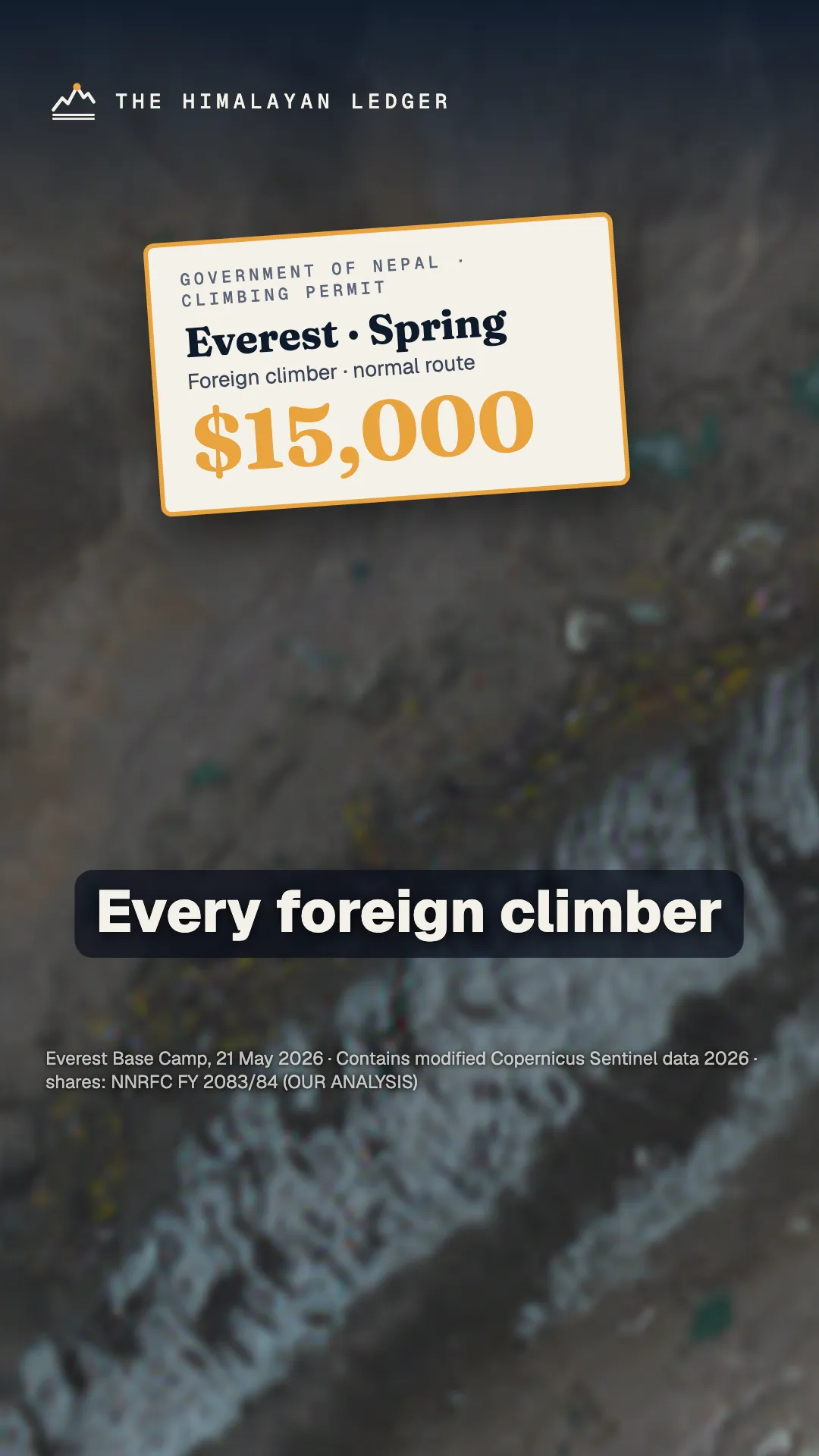
Every foreign climber pays Nepal $15,000 to climb Everest. We followed one permit through Nepal's own records, then the rest of the bill, the people who do the climbing, and the mountain's own bill.
The story in brief
This spring a record 492 permits were issued for Everest, and the royalty reached Rs 1.07 billion. Each foreign climber on the normal route pays $15,000 in spring, up from $11,000 since September 2025.
By law, mountaineering royalty is split 50% to the federal government, 25% to the province and 25% to local governments. Applying the national revenue commission’s shares for this year, one Everest permit sends about $3,350 to Koshi Province and about $1,900 to Khumbu Pasang Lhamu, the rural municipality where Everest stands.
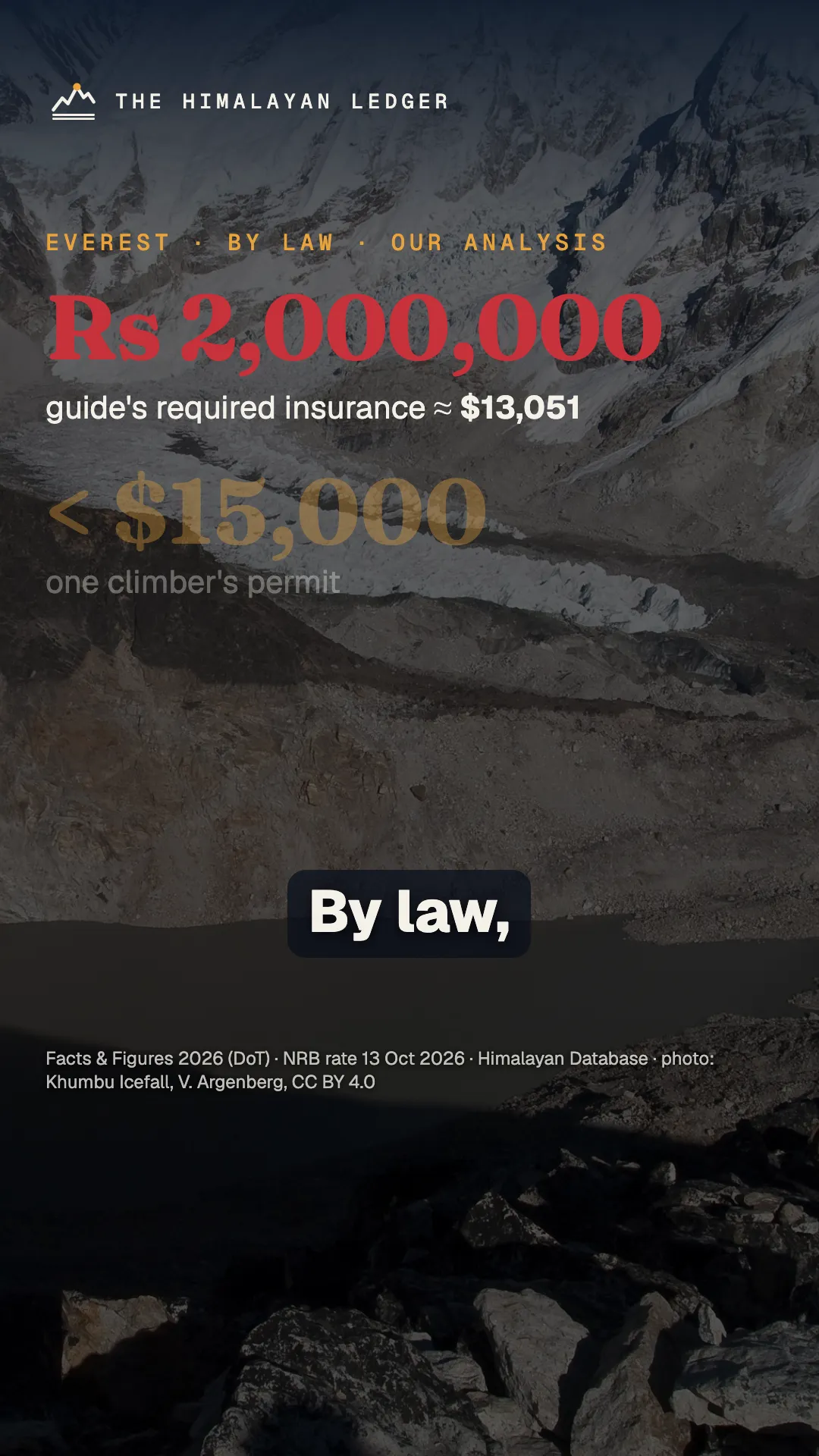
The permit is only part of the money. Hired climbers have made more than half of all Everest summits. Their legal minimum daily allowance is Rs 1,200, and their required accident insurance, Rs 2 million, is worth less than one foreign climber’s permit.
Key numbers
- 01
$15,000
Everest royalty for a foreign climber on the normal route in spring, from 1 September 2025 (up from $11,000)
Department of Tourism, Mountaineering in Nepal: Facts & Figures 20262026
- 02
$1,894
The share of one spring permit that reaches Khumbu Pasang Lhamu Rural Municipality, where Everest stands (25% local share × 50.5%). Our calculation.
NNRFC eighth annual report, royalty shares FY 2083/84FY 2083/84
- 03
492
Fee-paying Everest permits in spring 2026, a record, bringing in Rs 1.07 billion in royalty
- 04
Rs 1,200
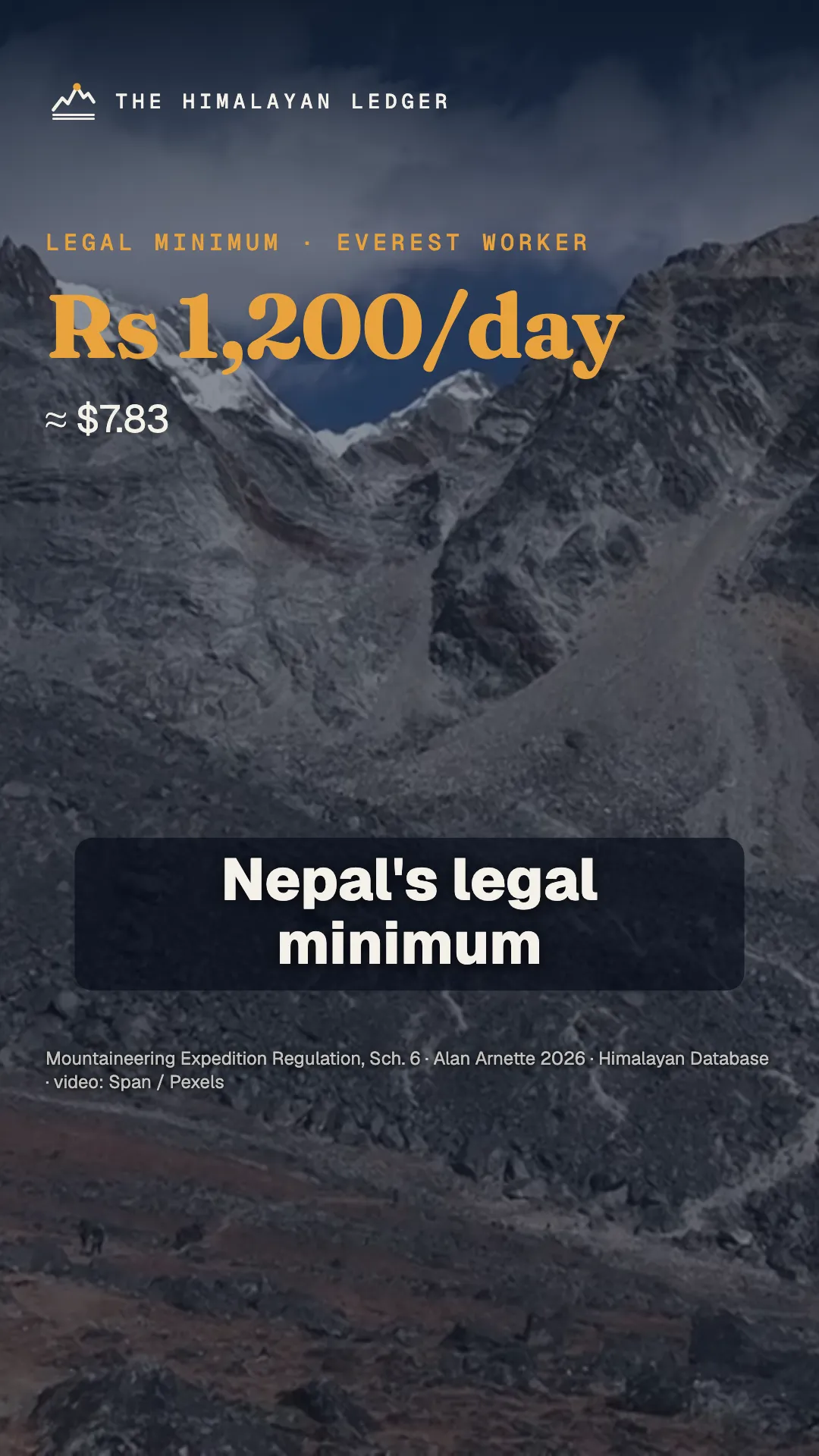
Legal minimum daily allowance for a mountain guide or high-altitude worker. It's a minimum, not actual pay.
Mountaineering Expedition Regulation 2059, Sixth Amendment2025
- 05
52%
Share of all Everest summits made by hired climbers through 2025 (7,096 of 13,755). Our query of the Himalayan Database.
The Himalayan Databasethrough 2025
- 06
≈ 1.2%
Everest's spring 2026 royalty compared with all of Nepal's travel income in FY 2025/26 (Rs 90.05 billion). Our calculation.
Nepal Rastra Bank, annual data 2025/2626 Aug 2026
Our analysis
Where one $15,000 permit goes
Nepal's Intergovernmental Fiscal Arrangement Act splits mountaineering royalty between the three levels of government, and the national revenue commission sets each province's and municipality's share every year.
Show the numbers
| Period | Value (US$) |
|---|---|
| Federal govt | 7,500 |
| Koshi Province | 3,347 |
| Khumbu Pasang Lhamu | 1,894 |
| 20 other local govts | 1,856 |
| Bagmati Province | 403 |
Source: Our analysis, applying the Intergovernmental Fiscal Arrangement Act split and NNRFC shares for FY 2083/84 to the $15,000 fee.
- Half of every permit, $7,500, goes to the federal government.
- The provincial quarter is split 89.264% to Koshi Province and 10.736% to Bagmati, about $3,347 and $403.
- The local quarter is shared among 21 local governments. Khumbu Pasang Lhamu, home to Everest, gets 50.5%, about $1,894. The other 20 share the remaining $1,856.
Caveat. These shares apply to the royalty only. Climbers also pay local and national park entry fees, a refundable $4,000 garbage deposit, and far larger sums to expedition companies, which this split doesn't cover.
Shorts from this story
Sources
Every figure in the video, and where it comes from. We link the original wherever we can.
- 01
Dept of Tourism, Mountaineering in Nepal: Facts & Figures 2025 and 2026 (fees, permits, royalty, insurance, garbage rules)
tourismdepartment.gov.np - 02
Dept of Tourism, Royalty Report, Autumn 2026
tourismdepartment.gov.np - 03
Mountaineering Expedition Regulation 2059, Sixth Amendment (daily allowance)
lawcommission.gov.np - 04
NNRFC, royalty shares FY 2083/84 and the Intergovernmental Fiscal Arrangement Act
nnrfc.gov.np - 05
The Himalayan Database (through 2025), our query
himalayandatabase.com - 06
Alan Arnette, How Much Does It Cost To Climb Everest? 2026
alanarnette.com - 07
Nepal Rastra Bank, annual 2025/26 (travel income) and exchange rate 13 Oct 2026
nrb.org.np - 08
World Bank, GNI per capita, Nepal
data.worldbank.org - 09
Kathmandu Post: fee rise (5 Feb 2025) · record revenue (6 May 2026) · record permits, Tibet side, serac (8 May 2026) · clean-up plan · tourism bill · rescue case
kathmandupost.comkathmandupost.comkathmandupost.comkathmandupost.comkathmandupost.comkathmandupost.com - 10
- 11
Park fee: Himalayan Times
thehimalayantimes.com - 12
Tibet side closure: ExplorersWeb
explorersweb.com
Our analysis: the permit split applies NNRFC's FY 2083/84 shares to the $15,000 fee; dollar figures use the NRB rate of 13 Oct 2026. The legal daily allowance is a minimum, not actual pay. The rescue case is an allegation; no court has ruled.
Transcript
Read the full narration
0:00 Base camp from space
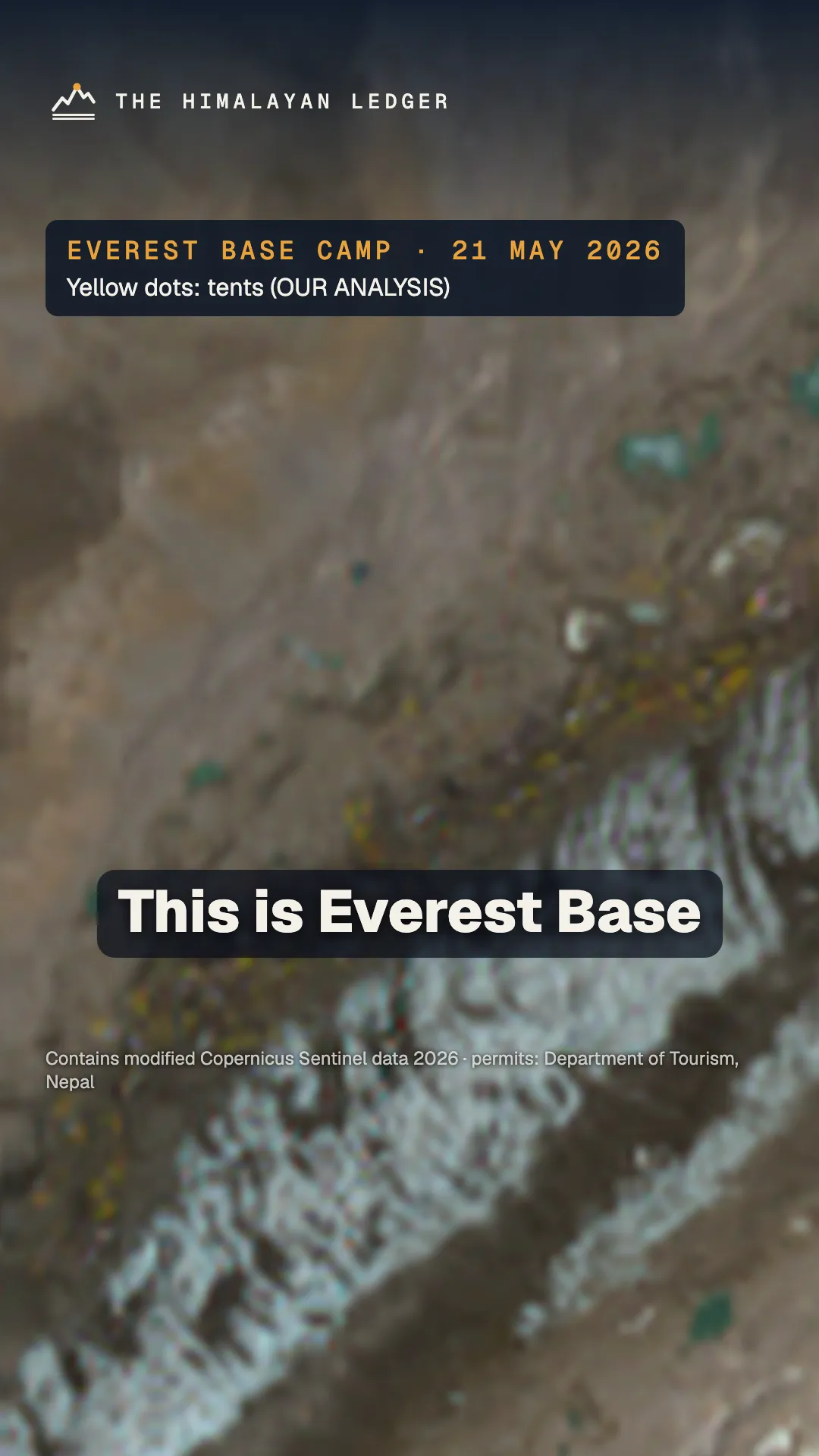
This is the base of Mount Everest, photographed from space on the 21st of May this year. Those yellow dots are tents. Hundreds of climbers and the people working for them, camped on a glacier.
Every foreign climber in that camp paid Nepal's government $15,000 just for permission to climb. This spring, a record 492 people paid it. So where does all that money go?
We followed one permit, using Nepal's own government records. Half of it goes to the federal government. A small slice reaches the mountain municipality where Everest stands. And by the end, you'll see why the man who carries your oxygen to the top is insured for less than the price of your permit.
0:45 The price of a summit
First, how much does it actually cost to climb Everest? Nobody publishes official prices. But Alan Arnette, who has tracked Everest expeditions for more than 20 years, surveys over 50 companies every season.
His answer for this year: most people pay between $40,000 and $80,000. With a Nepali company, the middle price was about $45,000. With a foreign company and a foreign guide, about $76,000. Into that price go oxygen at around $650 a bottle, gear that can cost $20,000 new, flights, food, tents, and the people who make the climb possible.
And one line on every bill is fixed by law: the permit. For a foreign climber in spring, $15,000. It went up from $11,000 in September last year. That's a third of a cheaper expedition, and about a fifth of an expensive one.
The permit is the part we can follow all the way down.
1:46 Follow the permit
Nepal's law treats climbing fees like the royalty from a river or a forest: money earned from a natural resource. And the law says how to split it. Half goes to the federal government.
A quarter goes to the province. A quarter goes to local governments. For Everest, the province's quarter is shared between two provinces. Koshi, where the mountain is, gets about 89%.
Bagmati gets the rest. The local quarter is split between 21 local governments. But one of them gets half of it: Khumbu Pasang Lhamu, the rural municipality where Everest stands, along with Namche Bazaar and base camp itself.
So out of one $15,000 permit: about $7,500 to the federal government. About $3,300 to Koshi Province. About $1,900 to Khumbu Pasang Lhamu. And about the same again, shared between the other 20 local governments.
Now multiply that. This spring, Everest permits brought in Rs 1.07 billion. That's a record too. Everest alone is about 87% of everything Nepal earns from climbing permits in spring.
Under this year's formula, Khumbu Pasang Lhamu's share of this spring's Everest money would be around Rs 135 million, roughly $880,000. It's real money for a mountain municipality. But it arrives late: royalties are shared out only after the fiscal year ends, and Khumbu's own officials have complained it isn't enough.
In 2024 the municipality raised its own entry fee for trekkers, saying it doesn't get much from the federal budget.
3:24 The rest of the bill
So the government gets the permit. Where does the other $30,000 to $60,000 go? Much of it goes to the companies running the expedition. Since about 2015, Nepali companies have taken over most of the business, and they're usually the cheaper option.
On the foreign model, a big slice goes abroad: to the company, and to an international guide who can earn $15,000 to $25,000 a season. And some of it is spent on the way up the valley. Climbers and trekkers fly into Lukla, pay a park entry fee and a separate local entry fee, sleep in lodges, hire porters and yaks, and buy food that gets more expensive with every day's walk.
That trail economy is bigger than the permits. In fact, even in a record year, Everest's permit money was only about 1% of what foreign visitors spent in Nepal.
4:16 The people who do the climbing
Every summit depends on Nepali climbing workers. Many, but not all, are Sherpa. They fix the ropes, carry the loads and the oxygen, and climb beside their clients to the top.
The Himalayan Database, which has recorded every expedition since the 1900s, counts 13,755 summits of Everest. More than half of them, 7,096, were made by hired workers. Last year, on Nepal's side, 831 hired workers climbed above base camp, alongside 500 paying clients.
What does the law guarantee them? Nepal's mountaineering rules set a minimum daily allowance the expedition must pay: Rs 1,200 a day for a high-altitude worker. That's about $8.
That's a floor, not the real pay. Experienced guides earn far more through contracts, summit bonuses and tips. Arnette reports certified Sherpa guides can now earn up to $10,000 in a season. In a country where the average income is about $1,500 a year, that's a lot.
But it's earned in the most dangerous workplace on Earth. Since the 1920s, 344 people have died on Everest. 134 of them were hired workers. They cross the Khumbu Icefall far more often than their clients.
This spring, a block of ice the size of a building hung over the route for 19 days. When part of it fell, 4 people were hurt. Now, the promise from the start.
By law, every climbing guide must be insured against accidents for at least Rs 2 million. Rs 2 million is about $13,000. Less than one climber's permit.
6:01 The mountain's bill
There's one more bill: the one the mountain pays. In the last financial year, 83 tonnes of garbage were brought down from Everest and its two neighbours, Lhotse and Nuptse. Almost 32 tonnes of it was human waste.
Each team leaves a $4,000 deposit and gets it back only if every climber brings down 8 kilos of rubbish. In 2024, Nepal's Supreme Court ordered the government to cap climbers based on what the mountain can handle.
Last December, the government launched its first five-year plan to clean Everest. Even the rescues have become a business. In March, Nepal's government attorney filed a case against more than 30 people over fake helicopter rescues of climbers and trekkers, staged to claim insurance.
At the time of writing, the court has not ruled.
6:50 So, who gets the money?
This year showed how fragile all of it is. China kept Everest's Tibetan side closed, which pushed more climbers to Nepal. In early May, Nepal's tourism chief said the Iran war, which we covered in our last video, was holding numbers back.
Days later, they set a record anyway. So, who gets the money from Mount Everest? On a cheaper expedition, about a third of the bill is the permit. Half of that permit goes to the federal government, and about an eighth of it reaches the municipality at the foot of the mountain.
The rest of the bill goes to companies, guides, and the long trail of lodges, porters and pilots. At the time of writing, Nepal's parliament is debating a new tourism law. Lawmakers have proposed auctioning Everest permits, requiring climbers to have climbed other big peaks first, and insuring climbing workers for Rs 50 million.
None of it has passed yet. Whether the people on that glacier get a bigger share may depend on what Nepal decides next. Every number in this video, with its source, is in the description.
Corrections
None so far. If you spot an error, tell us and we'll fix it here, with the date. How we handle corrections.
Credits
Satellite: contains modified Copernicus Sentinel data 2026 (Microsoft Planetary Computer). Terrain: Copernicus DEM GLO-30 (DLR, Airbus; EU/ESA). Boundaries: Survey Dept of Nepal/OCHA via geoBoundaries (CC BY 3.0 IGO). Map: Natural Earth.
Photos (Wikimedia Commons): Vyacheslav Argenberg (CC BY 4.0), Billjones94 (CC0), NASA.
Video: Tom Evans, ArtellChill, Amit Haware, Alan Arnette (Wikimedia Commons, CC BY 3.0); Pexels and Pixabay contributors.
Music: Pixabay (AtlasAudio, SigmaMusicArt, leberch).
Written and produced by The Himalayan Ledger. The narration is an AI-generated voice (Google Cloud Text-to-Speech) reading our own script.
More from the Ledger
· Cybersecurity
One Bug, Two Central Banks Offline: What Happened in South Asia
On 25 October we tried to open the websites of seven central banks in South Asia. Six opened. No hack was reported; the sites that went dark were switched off on purpose, after two critical flaws were found in PHP.
· Strait of Hormuz
Hormuz: What Seven Months of Shock Cost South Asia
The Strait of Hormuz is nowhere near South Asia, yet seven months of disruption put Sri Lankan drivers on fuel quotas, cut factory hours in Bangladesh and pushed up prices from Karachi to Kathmandu.
· Ganges
The River Deal That Expires This December
India and Bangladesh have split the dry-season Ganges at Farakka under one treaty since 1996. It was signed for 30 years, and it runs out on 12 December 2026.