Hormuz: What Seven Months of Shock Cost South Asia
The Strait of Hormuz is nowhere near South Asia, yet seven months of disruption put Sri Lankan drivers on fuel quotas, cut factory hours in Bangladesh and pushed up prices from Karachi to Kathmandu.
The story in brief
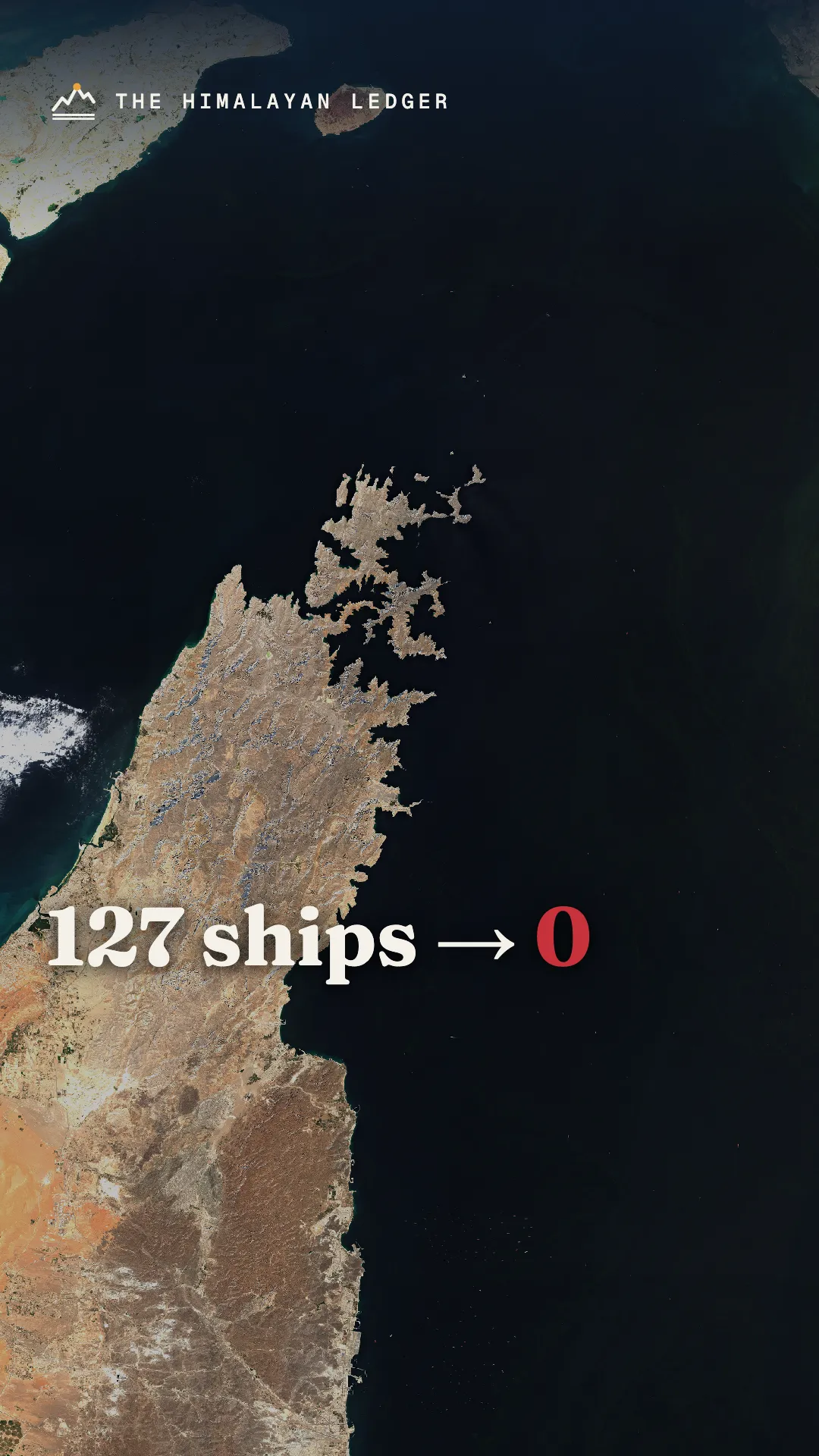
Before the war that began on 28 February 2026, about 20 million barrels of oil a day passed through the Strait of Hormuz, roughly a quarter of the world’s seaborne oil trade, and most of it went to Asia. Ship-tracking data counted 127 ships through the strait on 22 February. On 4 March it counted none. The strait was mostly shut, briefly reopened in June, and has been partly flowing again since September.
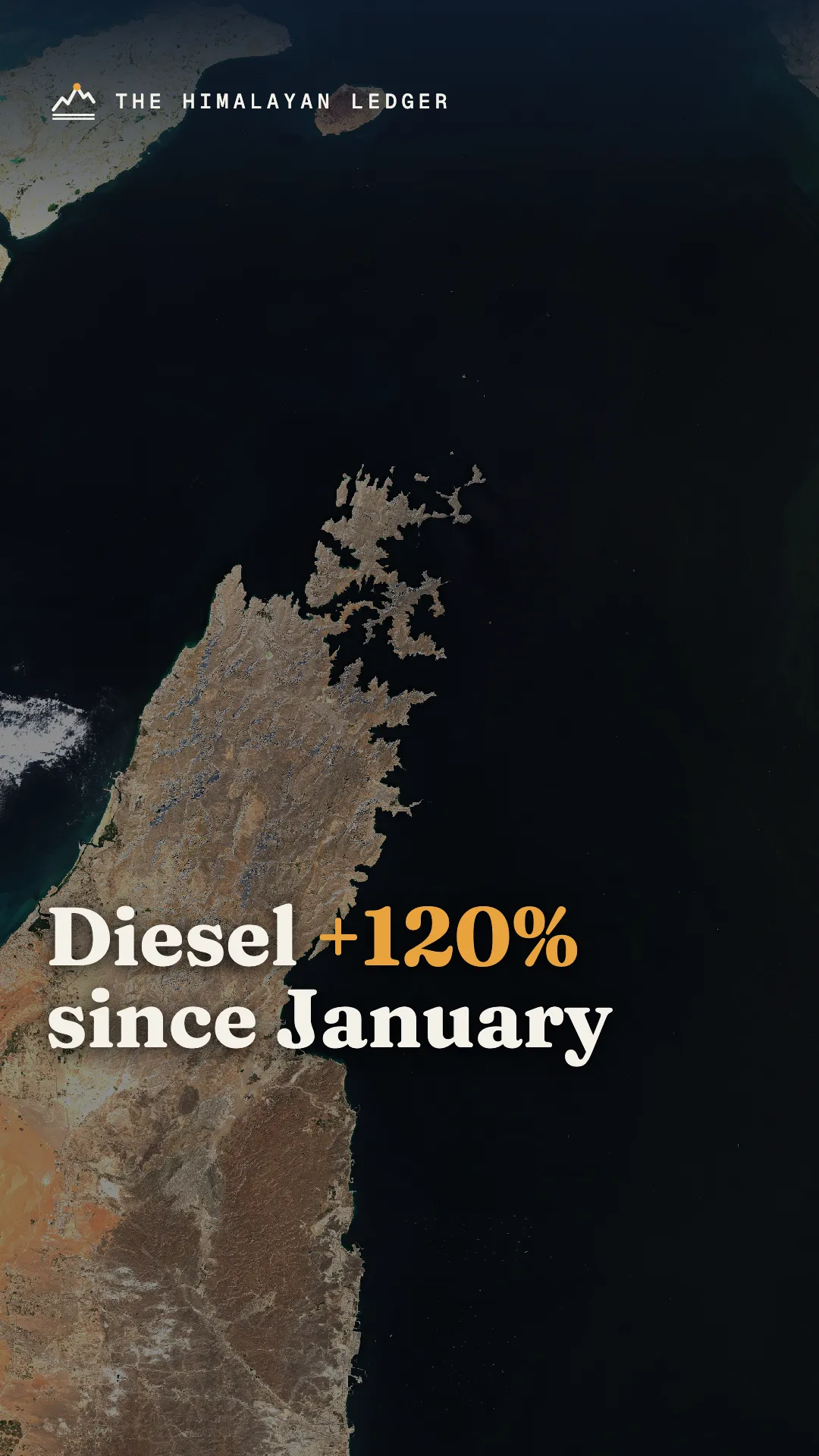
Countries like Sri Lanka import mostly refined fuel, and refined-fuel prices rose further than crude: by mid-September the world price of diesel was up about 120% since January. Sri Lanka brought back weekly fuel quotas, Bangladesh’s energy shortages cut factory hours, and Pakistan’s petrol and diesel prices rose by 40% or more.
And yet workers abroad sent home record amounts of money: $41.6 billion to Pakistan and $35.6 billion to Bangladesh in their latest fiscal years. More than half of Pakistan’s came from the Gulf, the region at the centre of the crisis.
Key numbers
- 01
127 → 0
Ships crossing the Strait of Hormuz on 22 February and on 4 March 2026. Counts rely on ships' own trackers and may understate traffic during the conflict.
IMF PortWatch, Daily Chokepoints Datadata to 4 Oct 2026
- 02
≈ 7.5%
Ship transits from 2 March to 4 October 2026 (1,384) compared with the 2025 pace for the same number of days. Our calculation.
IMF PortWatchdata to 4 Oct 2026
- 03
+120%
Rise in the world price of diesel since the start of 2026, as of 15 September (crude oil, Brent, +74%)
- 04
15 litres
Weekly petrol allowance for a car under Sri Lanka's reinstated QR fuel pass from 15 March 2026 (raised to 25 litres on 22 March)
Newsfirst15 Mar 2026
- 05
$41.6 bn
Record remittances to Pakistan in fiscal year 2026 (up 8.6%), more than half of it from Gulf countries
State Bank of Pakistan data, via Dawn9 Jul 2026
- 06
$35.6 bn
Record remittances to Bangladesh in fiscal year 2026 (up 17.3%)
The data
Seven months in one chart
The oil price traces the strait. It jumped when the strait closed in March, fell back after the brief reopening in June, and climbed again as the truce collapsed.
Show the numbers
| Season | Brent crude |
|---|---|
| Jan | 66.8 |
| Feb | 71.1 |
| Mar | 103.7 |
| Apr | 120.4 |
| May | 107.5 |
| Jun | 85.4 |
| Jul | 83.4 |
| Aug | 90.9 |
| Sep | 116.8 |
Source: World Bank Commodity Price Data (Pink Sheet), October 2026, CC BY 4.0.
- Brent averaged $71.1 a barrel in February, $120.4 in April and $85.4 in June, after a mid-June deal briefly reopened the strait. It rose to $116.8 in September.
- Refined products hurt more than crude. The IMF says diesel and petrol were still between 70% and 95% above prewar levels, and about a fifth of the world's refined-product supply was lost.
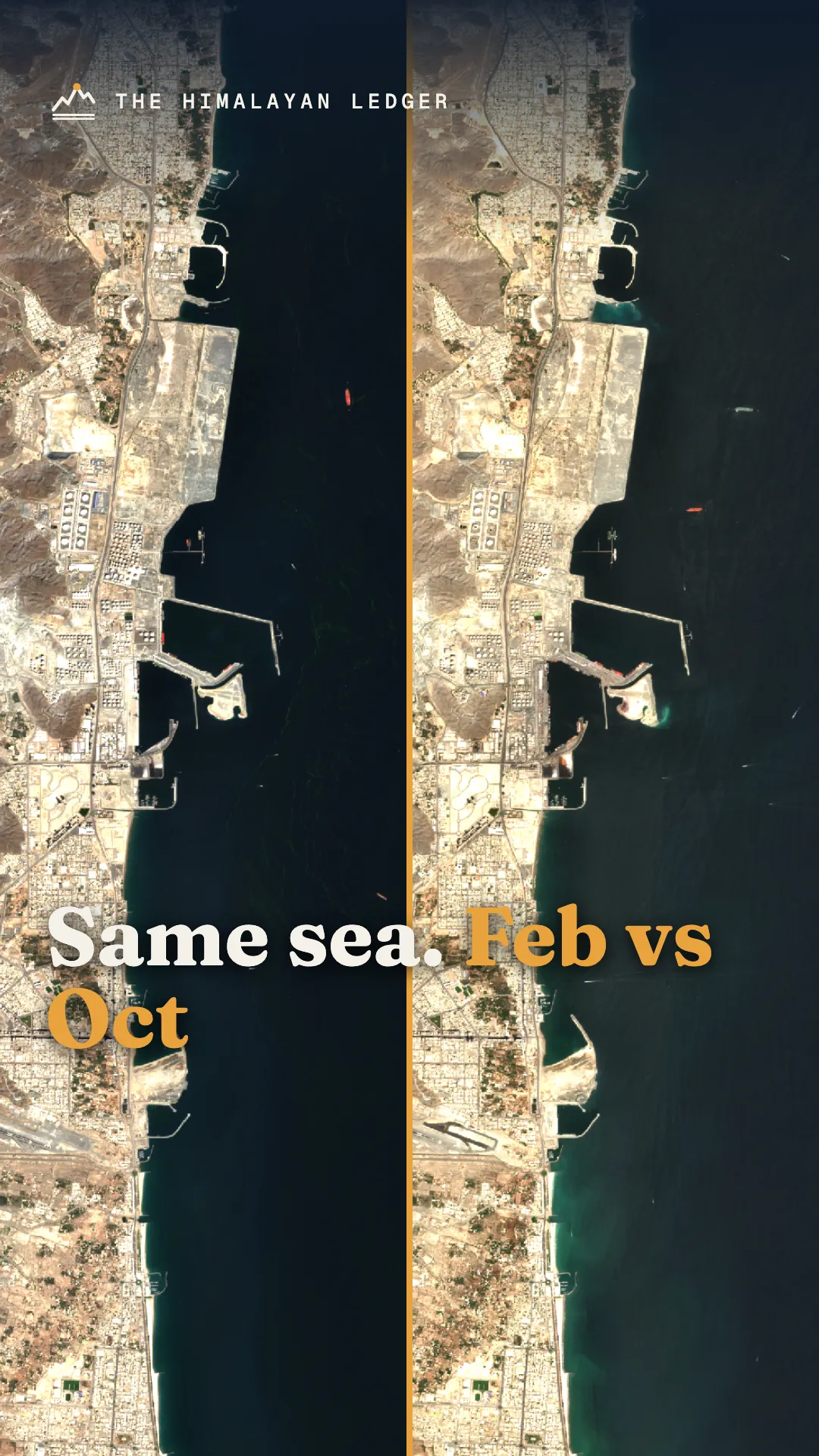
- Our snapshot from space: on two clear Sentinel-2 images of the sea off Fujairah (UAE), which has a pipeline that bypasses the strait, our automated count found around 64 ships on 21 February and around 107 on 4 October. It's two days, not a trend.
Caveat. Ship counts come from trackers that ships switch on themselves; during the conflict, more oil may have moved than the data shows. Monthly averages hide sharper daily swings (Brent peaked at about $126 in late March).
Shorts from this story
Sources
Every figure in the video, and where it comes from. We link the original wherever we can.
- 01
IMF, World Economic Outlook, October 2026 (ch. 1 and commodity special feature)
imf.org - 02
Ship transits: Source: International Monetary Fund, PortWatch, Daily Chokepoints Data (Strait of Hormuz), (counts ships with AIS trackers on · data to 4 Oct 2026)
portwatch.imf.org - 03
World Bank, Middle East, North Africa, Afghanistan and Pakistan Economic Update, October 2026
documents.worldbank.org - 04
World Bank, Macro Poverty Outlook, South Asia, October 2026
documents.worldbank.org - 05
World Bank, Sri Lanka Development Update, October 2026
documents.worldbank.org - 06
World Bank, Bangladesh Development Update, October 2026
documents.worldbank.org - 07
World Bank, Nepal Development Update, October 2026
documents.worldbank.org - 08
World Bank Commodity Price Data (Pink Sheet), October 2026, CC BY 4.0
worldbank.org - 09
U.S. Energy Information Administration, "Amid regional conflict, the Strait of Hormuz remains critical oil chokepoint" (16 Jun 2025)
eia.gov - 10
State Bank of Pakistan remittance data for FY26, as reported by Dawn (9 Jul 2026)
dawn.com - 11
Nepal Rastra Bank, Current Macroeconomic and Financial Situation (annual data 2025/26)
nrb.org.np - 12
- 13
April ceasefire, Al Jazeera (7 Apr 2026)
aljazeera.com - 14
July truce collapse, FOX 11 / AP (8 Jul 2026)
foxla.com - 15
Iran's position on reopening, Al Jazeera (4 Oct 2026)
aljazeera.com
Our analysis: the ship counts off Fujairah are our own automated count on two clear Sentinel-2 images (21 Feb and 4 Oct 2026), a snapshot, not a trend. Lines marked "our analysis" are our interpretation, not official statistics. We don't take sides in the war; this video is about its economic cost to South Asia.
Transcript
Read the full narration
0:00 The Hormuz shock
This is the Strait of Hormuz, photographed from space on the 21st of February this year. The next day, ship-tracking data counted 127 ships passing through it. Ten days later, on the 4th of March: zero.
This water is nowhere near South Asia. But what happened here put Sri Lankan drivers on a weekly fuel quota, cut factory hours in Bangladesh, and helped shrink the number of Nepalis leaving for Gulf jobs by more than a third.
And yet, in the financial year the war broke out in, Bangladesh and Pakistan both received more money from their workers abroad than ever before. How can both be true? To answer that, we need to start with what moves through this narrow strip of water.
0:47 The strait
The strait runs between Iran to the north and the tip of Oman's Musandam peninsula to the south. Before the war, about 20 million barrels of oil went through it every day. That's roughly a quarter of all the oil the world moves by sea.
It also carries about a fifth of the world's liquefied natural gas exports, mostly from Qatar. And most of it heads east. In 2024, 84% of the crude oil passing through the strait went to Asian markets.
The World Bank says South Asia has been hit especially hard, because of how much it relies on energy imported from the Middle East. On the 28th of February, the United States and Israel began striking Iran. Within days, traffic through the strait almost stopped.
1:33 Seven months in one chart
This is every ship our data saw crossing the strait, day by day, since the start of last year. Last year, it averaged about 85 a day. From early March, about six.
In April, a ceasefire was announced. The ships didn't come back. In mid-June, the United States and Iran signed a memorandum. For a few weeks the strait opened up, and on its busiest day 51 ships crossed.
About 90 million barrels of oil that had been stuck in the Gulf came out at once, and the oil price briefly crashed to $68. Then, in early July, the truce collapsed. Within days, the line was back near the floor.
But this chart has a blind spot. It only counts ships that broadcast their position. In a war zone, many switch their trackers off. According to the IMF, in September oil exports from the Gulf recovered to about 88% of pre-war levels, much of it back through Hormuz, because attacks in the Red Sea made the detour more dangerous.
Some oil skipped the strait altogether. The UAE pipes oil overland to Fujairah, a port outside it. On the 4th of October, the sea off Fujairah looked like this. We counted around 100 ships here, against around 60 on a clear day in February.
So the strait isn't simply closed. It's open some days, dangerous every day, and expensive all the time. At the time of writing, on the 13th of October, Iran's chief negotiator says it will not open until Iran's conditions are met.
3:11 Why fuel hurts more than crude
Here's what all that did to the oil price. Brent crude averaged $71 a barrel in February. In April, $120. After the June reopening, about $85.
And in September, back up to $117. But for much of South Asia, crude isn't the real problem. Sri Lanka, for example, imports almost three times as much ready-made fuel as crude oil.
And ready-made fuel got hit hardest. The IMF says diesel and petrol are still 70% to 95% above their pre-war prices. For a country like Sri Lanka, which buys ready-made fuel, that matters. The World Bank calculated that since January, the world price of diesel has risen about 120%, and jet fuel 126%.
It isn't only fuel. The world price of urea fertiliser nearly doubled between February and April.
4:06 Country by country
Start with Sri Lanka, whose economy collapsed in 2022 and had only just climbed back. In March, it brought back a fuel pass from that crisis. Every vehicle gets a QR code and a weekly quota.
At first, 15 litres a week for a car, and 5 for a motorbike. In July, it spent 68% more on fuel imports than a year earlier. Inflation went from 2% in March to 8% in August. And a current account that had been in surplus slipped into the red.
In Bangladesh, the World Bank says energy shortages cut factory hours and led to closures and layoffs. Growth slowed to 3.4%, and the World Bank expects no better next year. Fuel prices rose 15% to 21% between April and June, and another 15% in September.
To be fair, not all of this is Hormuz. Bangladesh's own gas fields have been running down for years, and it now imports a third of its gas. The war hit a system that was already fragile.
In Pakistan, petrol prices rose 40% or more after the conflict began, and diesel more than 40%. The IMF expects inflation to reach nearly 10% in the fiscal year to June 2027, up from about 7%.
The Maldives lives on tourism. After March, arrivals from Western markets fell sharply. By the end of June, after repaying a $500 million bond, its reserves were down to about $690 million, barely more than a month of imports.
In Nepal, the government halved customs duty on petroleum in April to soften the price jump. But Nepal's bigger exposure is people. In the year to mid-July, the number of Nepalis leaving for work in the Middle East fell by 39%, partly because the government temporarily stopped approving new departures as tensions rose.
And then there's India, the region's giant, and its exception. The IMF still expects it to grow about 7% this year, one of the fastest of any major economy, and one of the few energy importers whose forecast went up. That resilience has a price.
The World Bank says India's oil import bill is surging, and the government has raised subsidies and cut excise duties, which keeps its deficit at 7.4% of GDP.
6:28 The paradox: record remittances
Now, back to the puzzle from the start. In the financial year that ended in June, Bangladesh received a record $35.6 billion from workers abroad, up 17%. Pakistan: a record $41.6 billion.
More than half of it came from the Gulf, mostly Saudi Arabia and the UAE. Nepal's remittances were up 37% in rupees. Sri Lanka's, up about 21% in dollars between January and July. So why, during a Gulf war?
Part of the answer is timing. The money arriving now comes from people who left months or years ago. The World Bank says Bangladesh's record came from the large number of workers who went abroad between 2023 and 2025, and from families needing more help as prices rose.
Sri Lanka's growth came increasingly from workers in Britain and Australia, not just the Gulf. Which means the risk is still ahead. If fewer people leave this year, as Nepal's numbers already show, fewer people will be sending money home next year.
The World Bank lists exactly that, a long conflict cutting tourism and remittances, as a key risk for Nepal.
7:39 What next
So what happens now? The IMF's central forecast assumes the strait starts reopening in March 2027, and gets back to normal only by October 2027. Until then, it warns, poorer countries without fuel stocks could face shortages, outbid by richer buyers for the cargoes that do get through.
For South Asia, that's the real question. Not only whether oil gets through Hormuz, but who can afford it when it does. The Maldives is paying with thin reserves. Nepal and Bangladesh are leaning on remittances.
India is paying with its budget. And at the time of writing, nobody knows when the bill stops. Sources for every number are in the description. If you want South Asia explained through data, subscribe to The Himalayan Ledger.
Corrections
None so far. If you spot an error, tell us and we'll fix it here, with the date. How we handle corrections.
Credits
Satellite imagery: contains modified Copernicus Sentinel data 2026 (via Microsoft Planetary Computer). Maps: Natural Earth.
Photos: NASA / International Space Station (public domain).
Video: Pexels and Pixabay contributors (Pexels License, Pixabay Content License).
Music: Pixabay Content License (AtlasAudio, SigmaMusicArt, leberch).
Written and produced by The Himalayan Ledger. The narration is an AI-generated voice (Google Cloud Text-to-Speech) reading our own script.
More from the Ledger
· Cybersecurity
One Bug, Two Central Banks Offline: What Happened in South Asia
On 25 October we tried to open the websites of seven central banks in South Asia. Six opened. No hack was reported; the sites that went dark were switched off on purpose, after two critical flaws were found in PHP.
· Everest
Who Gets the Money From Mount Everest?
Every foreign climber pays Nepal $15,000 to climb Everest. We followed one permit through Nepal's own records, then the rest of the bill, the people who do the climbing, and the mountain's own bill.
· Ganges
The River Deal That Expires This December
India and Bangladesh have split the dry-season Ganges at Farakka under one treaty since 1996. It was signed for 30 years, and it runs out on 12 December 2026.