Why Nepal Can't Afford for Its Workers to Come Home
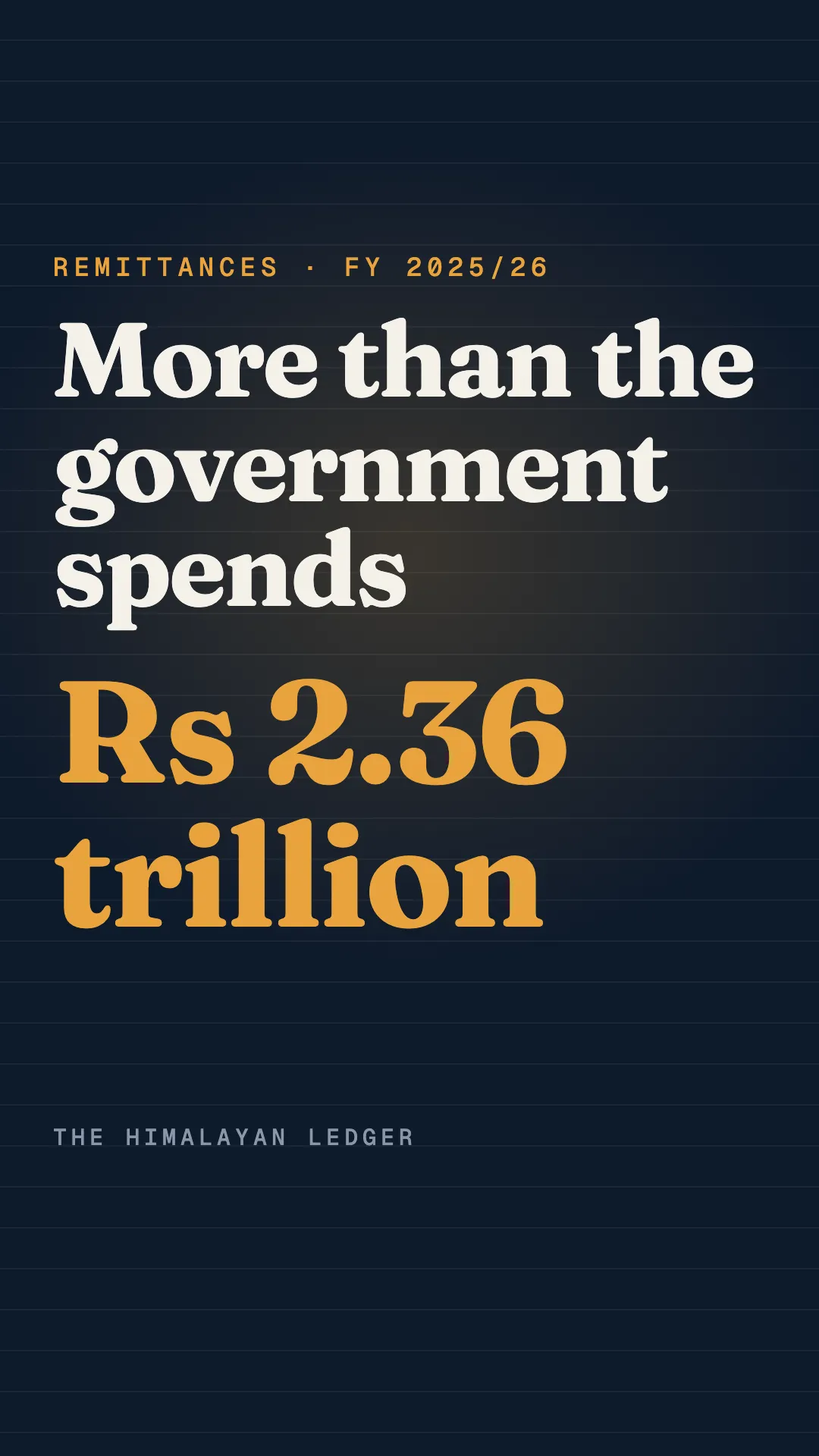
Nepalis working abroad sent home Rs 2.36 trillion last year, more than the government spent. Where the money goes, why it matters, and what happens if it stops.
The story in brief
In the fiscal year to mid-July 2026, Nepalis working abroad sent home Rs 2,363 billion, about 16 billion dollars, according to Nepal Rastra Bank. That’s about one and a half times what the government spent in the same year, and more than the value of everything Nepal imported.
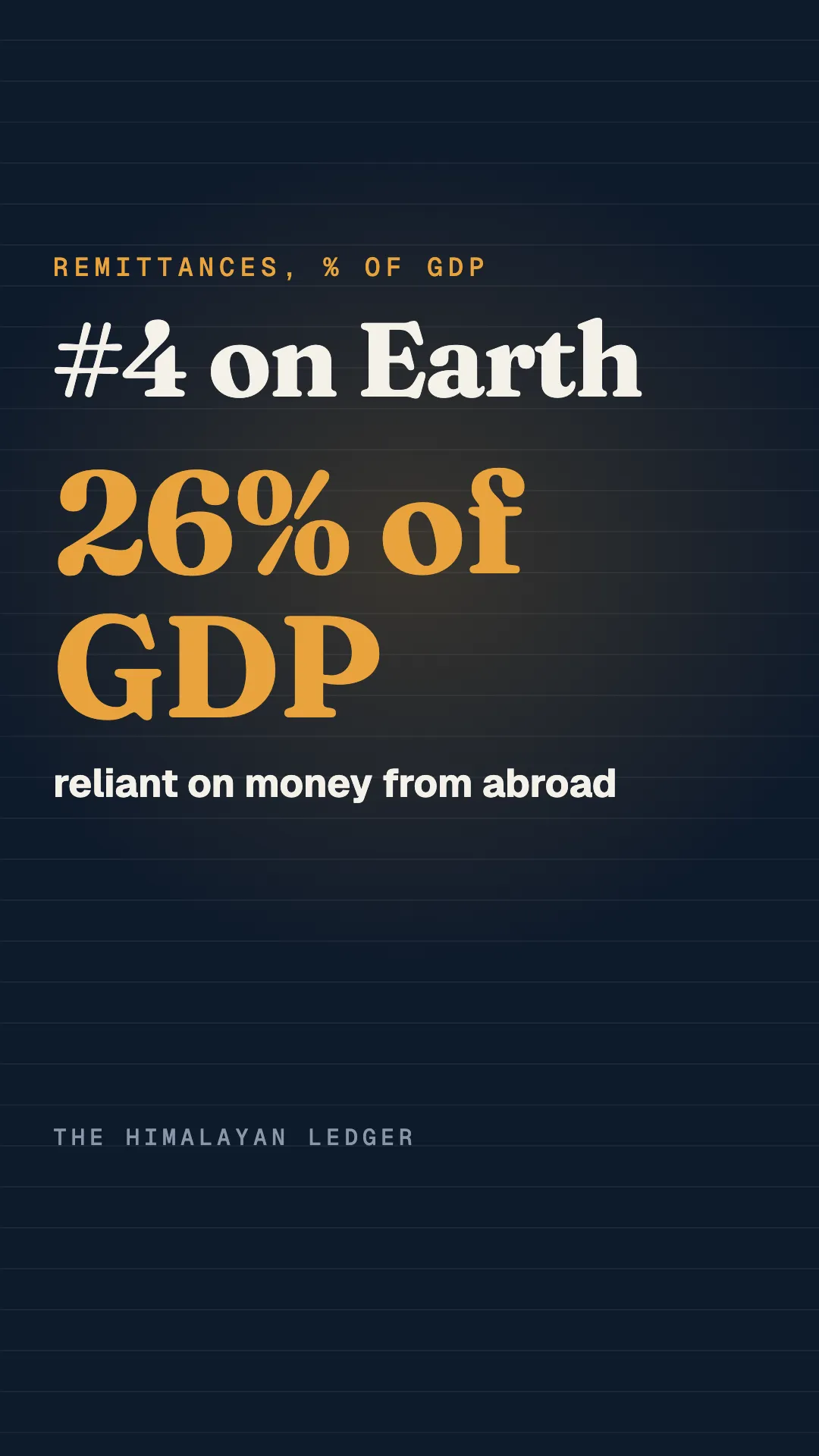
The World Bank puts remittances at 26% of Nepal’s GDP in 2024, the fourth-highest share of any country. About a quarter of households have at least one family member abroad, and the World Bank credits remittances with more than 30% of Nepal’s poverty reduction between 2011 and 2023.
The money also shapes the state. Trade taxes made up nearly 45% of Nepal’s tax revenue on average from 2015 to 2023. In our reading, a paycheck earned in Doha or Kuala Lumpur becomes a family’s spending, which becomes an import, which becomes tax revenue: in a real sense, part of Nepal’s government is funded by workers who aren’t in Nepal. Behind the money are people far from home. Since 2011/12, on average more than 600 Nepali migrant workers have died abroad every year.
Key numbers
- 01
Rs 2.36 trillion
Money sent home by Nepalis working abroad in FY 2025/26 (Rs 2,363.13 billion, up 37.1%)
Nepal Rastra Bank, Current Macroeconomic and Financial Situation26 Aug 2026
- 02
1.5×
Remittances compared with total government spending in the same year (Rs 1,582.17 billion). Our calculation from NRB figures.
Nepal Rastra Bank (figures from the Financial Comptroller General Office)26 Aug 2026
- 03
26.0%
Remittances as a share of Nepal's GDP in 2024. Only Tajikistan, Tonga and Nicaragua were higher.
World Bank, World Development Indicators (data updated 13 Jul 2026)13 Jul 2026
- 04
1 in 4
Nepali households with at least one family member abroad
- 05
30%+
Share of Nepal's poverty reduction between 2011 and 2023 that the World Bank attributes directly to remittances
- 06
600+
Nepali migrant workers who have died abroad each year on average since 2011/12, with over 1,200 deaths in both 2022/23 and 2023/24 (Foreign Employment Board records)
The data
How big Rs 2.36 trillion is
Set against the rest of Nepal's economy for the same fiscal year, remittances are the largest single flow of money in the country's accounts.
Show the numbers
| Period | Value (Rs billion) |
|---|---|
| Remittances | 2,363 |
| Imports | 2,096 |
| Govt spending | 1,582 |
| Govt revenue | 1,241 |
| Exports | 315 |
Source: Nepal Rastra Bank, Current Macroeconomic and Financial Situation (annual data, FY 2025/26), 26 Aug 2026. Values rounded.
- Remittances (Rs 2,363 billion) were larger than total merchandise imports (Rs 2,096 billion) and about 7.5 times exports (Rs 315 billion).
- They were about 1.5 times government spending and 1.9 times government revenue, and about 83 times foreign direct investment (equity only, Rs 28.49 billion). These ratios are our calculations from NRB's figures.
- Foreign-exchange reserves reached Rs 3,898 billion, enough for 19.6 months of imports. In our reading, the reserves are strong because remittances are strong, not because Nepal sells more to the world.
Caveat. Remittances are private money sent to families, not government income. The comparisons show scale, not that one replaces the other.
Shorts from this story
Sources
Every figure in the video, and where it comes from. We link the original wherever we can.
- 01
Nepal Rastra Bank, Current Macroeconomic and Financial Situation, Annual Data FY 2025/26 (26 Aug 2026): remittances, imports, exports, government spending and revenue, reserves, GDP growth, labour approvals, education payments, FDI.
nrb.org.np - 02
World Bank, Nepal Country Economic Memorandum 2025: migration, households, poverty reduction, trade taxes, exports, scenario modelling.
documents1.worldbank.org - 03
World Bank, World Development Indicators, personal remittances received (% of GDP), BX.TRF.PWKR.DT.GD.ZS (data updated 13 Jul 2026)
data.worldbank.org - 04
Government of Nepal, Nepal Labour Migration Report 2024: migrant deaths, destinations.)_peesvxa.pdf
giwmscdnone.gov.np - 05
WHO Nepal, National Suicide Prevention Helpline Service (9 Dec 2022)
who.int - 06
TPO Nepal, contact page
tponepal.org
Parts marked "OUR ANALYSIS" in the video are our interpretation, not official statistics. Illustrated examples (the worker in Doha, the family in Dhanusha) are not real people.
Transcript
Read the full narration
0:00 Rs 2.36 trillion
Last year, Nepalis abroad sent home Rs 2.36 trillion. That's about 1.5 times everything the government spent. It's more than all the goods the country bought from the rest of the world. And 7.5 times what Nepal sold to it.
In a sense, Nepal's biggest source of foreign money isn't something it sells. It's what its people earn abroad. Over the next few minutes, we'll follow that money, from a paycheck in the Gulf to the government's own accounts.
And we'll see why the biggest risk to Nepal's economy may not be that its workers come home… but that they don't. This is The Himalayan Ledger.
0:41 How big is it?
Let's put that number in context. Rs 2.36 trillion is about US$16 billion, and it grew 37% in a single year. Part of that jump is the rupee itself. In dollar terms the growth was 28%.
The gap is what you'd expect when each dollar sent home buys more rupees. Even so, it's huge growth. Now set it against the whole economy. According to the World Bank, remittances in 2024 were worth 26% of Nepal's GDP.
That's an amount equal to more than a quarter of everything the economy produces in a year. Only three countries on Earth depend on remittances more: Tajikistan, Tonga and Nicaragua.
In South Asia, nobody comes close. The World Bank found Nepal's share was nearly 3 times that of the next country in the region, Pakistan. To see how unusual that is, compare it with money from foreign investors.
Last year, new foreign direct investment into Nepal came to about Rs 28.5 billion. Remittances were more than 80 times larger. The World Bank puts it plainly: remittances significantly surpass both foreign investment and foreign aid.
They are the country's main source of foreign exchange. And this isn't money flowing to a handful of families. Around 1 in 4 households has at least one member living abroad. In 2021, 17% of Nepal's working-age men were living outside the country.
So how does a country end up here?
2:13 How it got this big
Go back to the year 2000. Remittances were worth about 2% of Nepal's GDP. By 2010, that had climbed past 21%. In 2015, it peaked at nearly 28%.
The World Bank's explanation is blunt: a lack of jobs at home. Between 1996 and 2023, Nepal issued more than 6.6 million new approvals for work abroad. That's an average of over 237,000 people every year.
By 2023, more than 7% of the entire population was living abroad. The typical migrant is young and male. The median age is 28, and more than two- thirds are men. They work in around 150 countries, but most go to the Gulf states and Malaysia.
Malaysia used to be the top destination for new workers. In the 2023-24 fiscal year, the United Arab Emirates took that spot for almost every province. By one important measure, it has worked.
The World Bank estimates that remittances directly account for over 30% of Nepal's poverty reduction between 2011 and 2023. The money has gone into household spending, and into education and healthcare.
But to see what this money does to the country as a whole, we have to follow it.
3:32 Follow one rupee
So let's follow a single rupee. This is an illustration, not a real person. Imagine a worker on a construction site in Doha. At the end of the month, part of his pay goes home to his family.
Let's say they live in Dhanusha. The family spends it on the household, on school fees, on healthcare. That's the first stop. But a lot of what that money buys was made somewhere else.
For every Rs 100 of goods Nepal buys from abroad, it sells only about Rs 15 worth back. Last year, Nepal imported Rs 2.1 trillion of goods and exported just over Rs 300 billion.
That's a trade gap of Rs 1.78 trillion. A gap that size would normally spell trouble. A country that buys far more than it sells can run out of foreign currency to pay for it.
Nepal doesn't, because the remittances are bigger than the gap. And notice what form the money arrives in: foreign currency. Dollars, riyals, ringgit. That is exactly what Nepal needs to pay for its imports.
The remittance doesn't just feed a family; it keeps the whole country's import bill paid. Now the second stop. When imported goods cross the border, the government taxes them.
There are customs duties, and many excise taxes are, as the World Bank puts it, "de-facto tariffs", higher on imported goods than on goods made at home. How much does that matter? Between 2015 and 2023, trade taxes alone made up nearly 45% of Nepal's tax revenue.
And this year, indirect taxes made up 65% of all government revenue. We know what happens when that chain breaks, because it already has. When the government restricted imports, imports fell, just as intended. But the World Bank found that tax revenue fell with them, and the fiscal deficit hit a decade high of 5.8% of GDP.
Think about what that means. A government trying to protect its foreign currency by importing less ended up with less money to spend. Its tax base doesn't sit in factories or offices.
A large part of it sits at the border. So here's our reading. It's an interpretation, not an official statistic. A paycheck earned in Doha or Kuala Lumpur becomes a family's spending, which becomes an import, which becomes tax revenue.
In a real sense, Nepal's government is funded by workers who aren't in Nepal.
5:57 The money that leaves
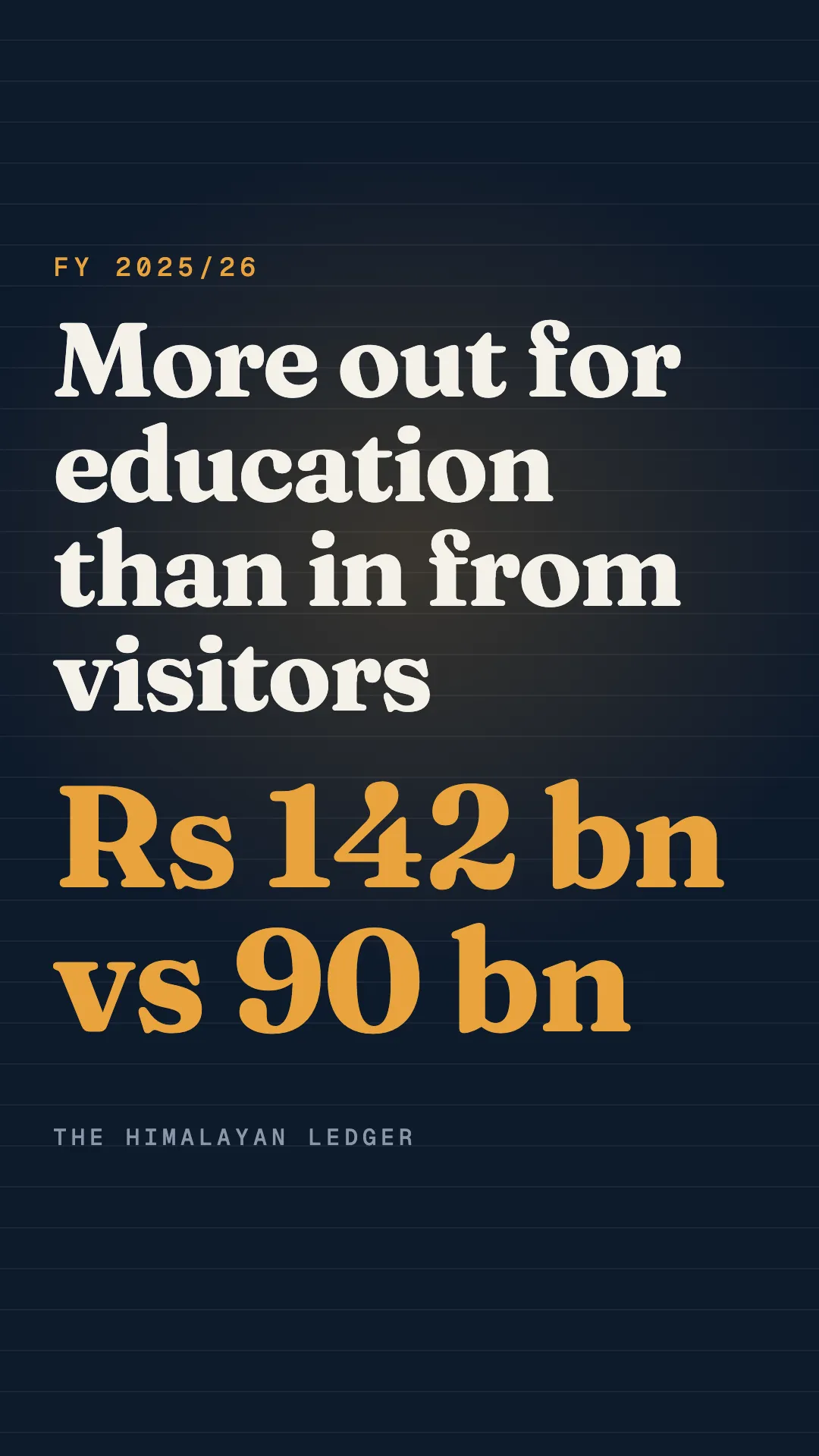
Remittances are only one side of the story. Money also leaves Nepal. Last year, Nepal paid about Rs 142 billion abroad for education. That's up from Rs 138 billion the year before.
To see how big that is, compare it with tourism. Visitors to Nepal brought in Rs 90 billion. Nepal sent out more than Rs 140 billion for education alone. It's also about five times the new foreign direct investment that came in.
And set against remittances, the education bill equals about Rs 6 in every Rs 100 that come in. What we can't tell from these figures is whose money pays those fees, or how much of it comes from families that receive remittances.
This report doesn't break that down, so we won't guess. What the data does show is a second reason people leave. The World Bank notes that migration for education has risen over the last decade, though work abroad is still the main reason.
And the scale of absence has been steady and large. In the 2021 census, almost 1 household in 4 had at least one member living abroad, and people living abroad were 7.5% of the population. So workers leave to earn, and money flows in.
Students leave to learn, and money flows out. Either way, a growing part of Nepal's economic life is happening across its borders.
7:23 The human cost
So far, we've counted money. But some costs don't show up in rupees. According to the government's own Labour Migration Report, on average more than 600 Nepali migrant workers have died abroad every year since 2011.
In both of the last two years on record, the number was over 1,200. Add it up across the Board's records since 2008, and the total is more than 13,000. In the 2023-24 fiscal year, the Foreign Employment Board gave financial assistance to the families of 1,346 workers who had died.
The most deaths were recorded in Saudi Arabia, 348, and in Malaysia, 345. Most were recorded simply as "natural causes", with no further explanation. Suicide and traffic accidents were among the other major causes. In 2023-24 alone, 183 deaths were recorded as suicide, and 135 as traffic accidents.
If you, or someone you know, is struggling, help is available. In Nepal, you can call 1166, the National Suicide Prevention Helpline. If you're outside Nepal, your local crisis line can help. The details are on screen and in the description.
Behind these figures are the 1 in 4 households with someone abroad, families who live with that distance every day. Remittances are behind more than 30% of Nepal's poverty reduction. And these are the costs.
Both are true at the same time. An honest account has to hold both.
9:02 The catch
On paper, Nepal's finances look stronger than ever. Foreign-exchange reserves jumped 46% in a single year, to US$25.3 billion. That's enough to pay for 19.6 months of imports. Its balance with the rest of the world, the current account, ran a surplus of Rs 924 billion.
But look at what's underneath. The economy itself grew just 3.85%. Exports barely move. The World Bank notes that since 2014 they've averaged about 7% of GDP, and that high tariffs and trade taxes have created what it calls an "anti-export bias".
Put simply, the reserves are strong because the remittances are strong, not because Nepal is selling more to the world. So what could change? The first risk is obvious: the money slows down.
Remittances depend on economies thousands of kilometres away. The World Bank gives a specific example: a slowdown in construction in the Gulf. In its modelling, if remittances grew just 2 percentage points slower than expected each year, Nepal's real GDP would be around 2% lower, year after year, over the medium term.
There's also an early signal worth watching. Last year, the number of people getting first-time approval to work abroad fell from about 506,000 to 406,000. Renewals, people extending work abroad they already had, rose to almost 386,000.
We don't yet know why, and we're not going to guess. But it's a number to watch. The second risk is the one almost nobody talks about. It isn't that workers come home.
It's that they don't. The World Bank modelled what happens if migrants begin settling abroad permanently, with their families. If just 5% did, Nepal's GDP would be permanently almost 3% lower.
If 20% did, the loss would be more than 10%. Because remittances only flow while there's a family at home to send them to.
11:03 Closing the books
So let's close the books. In this video, we've followed one rupee from a building site in the Gulf, through a family's kitchen, across a border, and into a government's accounts. In the credit column: Rs 2.36 trillion a year.
More than 30% of Nepal's poverty reduction. Reserves that would cover more than a year and a half of imports. In the debit column: an economy that sells Rs 15 for every Rs 100 it buys. A government that leans on taxing imports.
And more than 1,200 workers who didn't come home, in each of the last two years on record. For a generation, work abroad has carried a large part of Nepal's economy. The question for the next one is whether that money can help build an economy where fewer people have to leave to earn a living.
If you want to understand how this region really works, one ledger at a time, subscribe.
Corrections
None so far. If you spot an error, tell us and we'll fix it here, with the date. How we handle corrections.
Credits
Written and produced by The Himalayan Ledger. The narration is an AI-generated voice (Google Cloud Text-to-Speech) reading our own script. All graphics are our own. Music: Pixabay Content License (tracks by absolutesound, andriig, lnplusmusic and moodmode).
Written and produced by The Himalayan Ledger. The narration is an AI-generated voice (Google Cloud Text-to-Speech) reading our own script.
More from the Ledger
· Cybersecurity
One Bug, Two Central Banks Offline: What Happened in South Asia
On 25 October we tried to open the websites of seven central banks in South Asia. Six opened. No hack was reported; the sites that went dark were switched off on purpose, after two critical flaws were found in PHP.
· Everest
Who Gets the Money From Mount Everest?
Every foreign climber pays Nepal $15,000 to climb Everest. We followed one permit through Nepal's own records, then the rest of the bill, the people who do the climbing, and the mountain's own bill.
· Strait of Hormuz
Hormuz: What Seven Months of Shock Cost South Asia
The Strait of Hormuz is nowhere near South Asia, yet seven months of disruption put Sri Lankan drivers on fuel quotas, cut factory hours in Bangladesh and pushed up prices from Karachi to Kathmandu.