David Warner Joined Nepal's League. Who's Paying for It?
Warner, Russell and Miller joined the Nepal Premier League this season. So who pays? We follow the NPL's money and compare it with the IPL and PSL. Players' fees aren't published, so we don't guess them.
The story in brief
The Nepal Premier League is in its third season, and this year David Warner, Andre Russell and David Miller joined its teams. The players’ fees have never been published, so we followed the money that has been.
In season 2 the league took in Rs 47.4 crore, spent Rs 22 crore, and split what was left: Rs 16.2 crore to the eight franchises and Rs 9.2 crore to the Cricket Association of Nepal. For season 3, the TV, streaming and ticketing rights alone were sold for Rs 33.5 crore, and CAN’s treasurer expects gross revenue of Rs 1.5 billion.
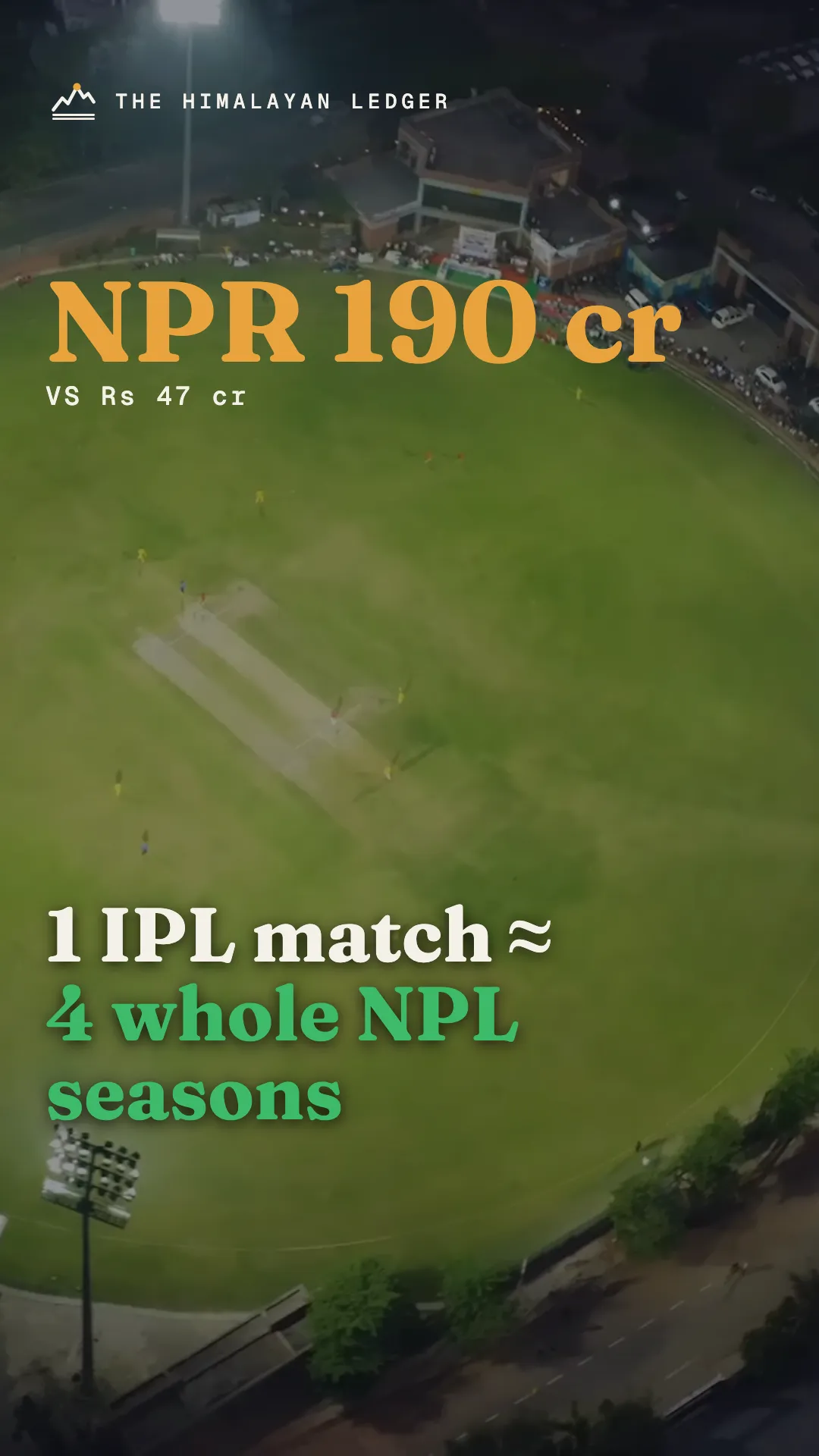
Next to India’s league, it’s still small. By our calculation, the IPL’s media rights are worth about four times the NPL’s whole season-2 revenue for every single match. But season 3 adds DRS, official T20 status from the ICC and bigger prize money, and in our reading the league is betting that bigger names bring bigger crowds and sponsors.
Key numbers
- 01
Rs 47.4 crore
NPL season 2 gross revenue (Rs 473.6 million), from the league's governing council report to CAN
Kathmandu Post7 Apr 2026
- 02
Rs 16.2 crore
Paid to the eight franchises as their 50% share of season 2's income after expenses
Kathmandu Post7 Apr 2026
- 03
Rs 33.5 crore
Season 3 TV, streaming and ticketing rights combined (NetTV Rs 18.04 crore, Himalaya Television Rs 14.64 crore, eSewa Rs 85 lakh)
CAN statement, via Ratopati7 Sep 2026
- 04
≈ 4×
IPL media rights per match compared with the NPL's entire season 2 revenue. Our calculation (INR 48,390 crore ÷ 410 matches, at 1 INR = 1.6 NPR).
- 05
Rs 1.5 crore
Prize for the season 3 winner (Rs 15 million), up from Rs 10 million in the first two seasons
Kathmandu Post25 Oct 2026
- 06
Rs 1.5–2 crore
Estimated cost of bringing DRS to the league this season, shared by CAN and the franchises
Kathmandu Post23 Oct 2026
The data
Where season 2's money went
The league publishes its accounts as a season total, reported to the Cricket Association of Nepal months after the tournament.
Show the numbers
| Period | Value (Rs crore) |
|---|---|
| Gross revenue | 47.4 |
| Expenses | 22 |
| To franchises | 16.2 |
| To CAN | 9.2 |
Source: NPL Governing Council report to CAN, via the Kathmandu Post, 7 Apr 2026. Rounded.
- Season 2 took in Rs 473.6 million and spent Rs 219.6 million, leaving Rs 254 million before sharing.
- Half went to the eight franchises (Rs 161.9 million), and CAN kept Rs 92.1 million.
- Season 1 took in Rs 277 million, so revenue grew by about 70% in a year (our calculation). For season 3, CAN's treasurer expects Rs 1.5 billion; that's a projection, not a result.
Caveat. Team-level sponsorships and player fees are not in the league's figures. The title sponsorship's value has never been disclosed.
Shorts from this story
Sources
Every figure in the video, and where it comes from. We link the original wherever we can.
- 01
Season 2 accounts (NPL Governing Council report to CAN), Kathmandu Post, 7 Apr 2026
kathmandupost.com - 02
Season 1 accounts, Desh Sanchar, 1 Aug 2025
english.deshsanchar.com - 03
Season 3 TV, streaming and ticketing rights (CAN statement), Ratopati, 7 Sep 2026
english.ratopati.com - 04
Franchise auction 2024, Cricnepal, 5 Sep 2024
cricnepal.com - 05
Title sponsor, Kathmandu Post, 16 Nov 2024
kathmandupost.com - 06
Prize money and CAN's season 3 expectation, Kathmandu Post, 25 Oct 2026
kathmandupost.com - 07
What's new in season 3 (DRS cost, ICC sanction, overseas rules, seats), Kathmandu Post, 23 Oct 2026
kathmandupost.com - 08
DRS features (NPL announcement), Nepal Views, 20 Oct 2026
english.nepalviews.com - 09
Ticket prices, Nepali Telecom, 23 Oct 2026
nepalitelecom.com - 10
Warner, Kathmandu Post, 15 Sep 2026
kathmandupost.com - 11
Miller, Kathmandu Post, 23 Oct 2026
kathmandupost.com - 12
Russell, Onlinekhabar
english.onlinekhabar.com - 13
Auction 2026 and the lucky draw, Kathmandu Post, 7 Jul 2026
kathmandupost.com - 14
2024 final, Ekantipur
ekantipur.com - 15
2025 final, Himalayan Times
thehimalayantimes.com - 16
Opening night 2024, Onlinekhabar, 1 Dec 2024
english.onlinekhabar.com - 17
Nepal T20 League deal, Onlinekhabar, 5 Jan 2023
english.onlinekhabar.com - 18
Audit and transparency, Ratopati, 25 Oct 2026
english.ratopati.com - 19
IPL auction (Cameron Green), ESPN, 16 Dec 2025
africa.espn.com - 20
IPL media rights 2023-27, BCCI
bcci.tv - 21
PSL TV rights 2024-25, Cricket Pakistan
cricketpakistan.com.pk - 22
NPR-INR fixed rate (1 INR = 1.6 NPR), Onlinekhabar
english.onlinekhabar.com
Our analysis: INR converted at 1.6. "About four times" = IPL media rights per match (INR 48,390 crore / 410 matches = NPR 189 crore) vs NPL season 2 gross revenue (NPR 47.4 crore). Team-level sponsors are not in the league's figures.
Transcript
Read the full narration
0:00 The toss: one IPL player vs a whole NPL season
Last season, the Nepal Premier League's own books show it brought in about Rs 47 crore. Now look at this man. Last December, one IPL team paid INR 25 crore for him at an auction.
In Nepali money, that's about Rs 40 crore. One player. Almost a whole league. Quick intro if you're new.
The NPL is Nepal's own T20 league. 8 teams, one ground in Kirtipur, and a month of cricket, running until the 21st of November. And this season, the NPL went big anyway.
Superstar names. Ball-tracking replays. An official stamp from the ICC. So who's actually paying for all this cricket?
And does the money add up? Let's follow it, ball by ball.
0:44 Powerplay: where the money comes from
First question: where does the money come in? Quick money lesson first. 1 crore is 10 million rupees. Keep that in your pocket.
The biggest deals we can see are for television. For this season, Himalaya Television bought the rights to show it on TV in Nepal. And NetTV bought the right to stream it to the whole world, for Rs 18 crore.
Add the ticketing deal, and the rights come to about Rs 33.5 crore. For just this one season. The second pipe is you, in the stands. A league match ticket starts at Rs 500.
eSewa sells the tickets, keeps 5%, and the cricket board keeps the rest. Third pipe: sponsors. The title sponsor is Siddhartha Bank, on a 5-year deal. The price?
Never made public. And the fourth pipe is the strangest one. The teams themselves. In 2024, companies bid to own the 8 teams.
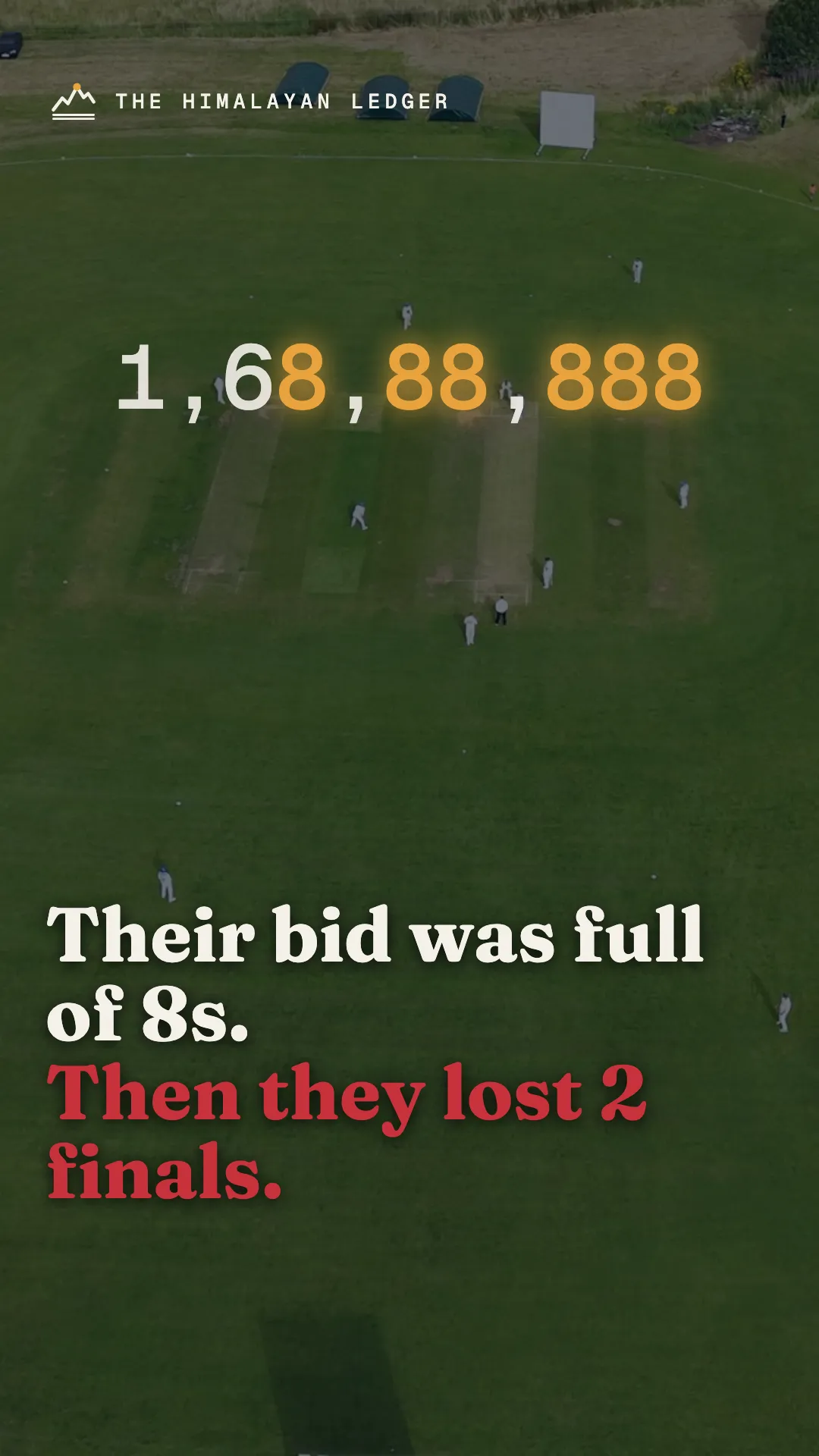
A medical college bought one. A newspaper house bought another. A construction company bought a third. All 8 bids together came to almost Rs 17 crore.
And look closely at the bids. Kathmandu's was almost all threes. And Sudurpaschim's was full of the number eight. Why?
They've never said. But remember those eights. They come back later. So, four pipes: TV, tickets, sponsors and teams.
Now, where does it all go?
2:13 Middle overs: where the money goes
Let's open last season's books. These are the cricket board's own figures, from April this year. In: about Rs 47 crore. First, the bills.
Running the tournament cost about Rs 22 crore. That leaves about Rs 25 crore to share. Most of it goes to the teams. About Rs 16 crore, shared between the 8 franchises.
And what's left with the cricket board? About Rs 9 crore. That's a big jump. After the first season, the board kept only about Rs 2.5 crore.
In one year, the league's income grew by about 70%. Not bad for a league that, a few years ago, didn't exist. So the league is growing fast. But here's the strange part.
It's still small enough that, last December, a single IPL player went for nearly as much as this entire scoreboard.
3:05 Strategic timeout: the stars, the auction, the lucky draw
Which raises the obvious question. How does a league this size sign David Warner? Or Andre Russell? Or David Miller?
The honest answer: we don't know what they're paid. The fees have never been published. And the auction itself is tiny by IPL standards. This July, the top price was Rs 20 lakh, for Nepal's own Aasif Sheikh.
The bidding hit the maximum, so his team was decided by a lucky draw. What we do know is that the rules opened the door wider. Teams can now carry up to 8 overseas players, up from 6. But only 4 can play in any one match.
And every team must field at least one player from an ICC Associate nation, the countries outside cricket's top table, like Nepal itself. The prize got bigger too. This season's champion takes home Rs 1.5 crore.
So who's lifted it so far? Season one: Janakpur Bolts. Season two: Lumbini Lions. And the team they beat in both finals?
Sudurpaschim. The team with all the eights.
4:12 Big hitters: the South Asia ladder
So, how big is the NPL really? Let's put it on the South Asia ladder. We'll compare one thing: what broadcasters pay to show each league. At the top, India's IPL.
Its TV and streaming rights sold for about INR 118 crore, per match. In Nepali money, that's almost NPR 190 crore. For one match. That's about 4 times everything the NPL earned in its whole second season.
Pakistan's PSL sits in the middle. Bangladesh and Sri Lanka don't publish what their leagues' rights sell for. And the NPL? About NPR 33 crore for this whole season.
So Nepal is on the bottom rung. But it is on the ladder. And look at the ages. The IPL started in 2008.
Pakistan's league in 2016. Nepal's is in only its third season.
5:10 The pitch: what this season is betting on
Now, the NPL hasn't always been smooth. Before it, Nepal tried a different T20 league with a private partner, on an 8-year deal worth about Rs 33 crore. For the first edition, the board says it was owed about Rs 3.9 crore.
It got Rs 1.2 crore. The partner's co-founder left for India, and the board said the deal was over. So when the NPL launched in 2024, the cricket board organised it itself. And on its very first night, the tickets had sold out 3 days early.
Then more fans turned up than could get in. There was a stampede at the southern gate. At least 8 people were hurt, including police officers. Fans said tickets were oversold, and the ticket company later offered refunds to people turned away.
Two seasons later, the board is spending to fix that. About 2,000 extra seats, and a different ticket partner. And for the first time, DRS. 3D ball-tracking and AI edge detection, for LBWs, run-outs, stumpings and no- balls.
It costs around Rs 1.5 to 2 crore, split between the board and the teams. Why bother? Because on the 16th of October, the ICC sanctioned this season. Runs and wickets now count in players' official T20 records.
6:29 Final over: so who pays?
So, final over. Who pays for the Nepal Premier League? The biggest deals we can see are with the broadcasters. About Rs 33 crore this season, for TV and streaming.
Then the fans in the stands, the sponsors, and the companies that own the teams. This season, the board says it expects about Rs 20 crore from sponsors, and more than Rs 70 crore from tickets and broadcasting. Those are the board's own expectations.
We'll check the real numbers when they're out. And one thing we still can't tell you: whether the teams make money. Their accounts aren't published, and the league's audit is still waiting for board approval.
So, 3 things to watch this season. Do the crowds fill those new seats? Do the stars bring in viewers from outside Nepal? And does the board publish the real numbers afterwards?
Here's the scoreline. A whole season of the NPL earned a little more than one IPL player cost. But the IPL has had almost 20 years to get this big. The NPL has only just walked out to bat.
Sources: the Cricket Association of Nepal, the Kathmandu Post, and other Nepali and Indian outlets. Every link is in the description. If this helped, like it, share it with someone who'd find it useful, and subscribe to The Himalayan Ledger.
Tap the bell so you don't miss the next one.
Corrections
None so far. If you spot an error, tell us and we'll fix it here, with the date. How we handle corrections.
Credits
Video: Pexels contributors. Sound effects and music: Pixabay (AtlasAudio, The_Mountain, Kulakovka, BombinSound).
Written and produced by The Himalayan Ledger. The narration is an AI-generated voice (Google Cloud Text-to-Speech) reading our own script.
More from the Ledger
· Cybersecurity
One Bug, Two Central Banks Offline: What Happened in South Asia
On 25 October we tried to open the websites of seven central banks in South Asia. Six opened. No hack was reported; the sites that went dark were switched off on purpose, after two critical flaws were found in PHP.
· Everest
Who Gets the Money From Mount Everest?
Every foreign climber pays Nepal $15,000 to climb Everest. We followed one permit through Nepal's own records, then the rest of the bill, the people who do the climbing, and the mountain's own bill.
· Strait of Hormuz
Hormuz: What Seven Months of Shock Cost South Asia
The Strait of Hormuz is nowhere near South Asia, yet seven months of disruption put Sri Lankan drivers on fuel quotas, cut factory hours in Bangladesh and pushed up prices from Karachi to Kathmandu.